Tuesday, April 10, 2018

Castles and Houses

Tuesday, April 3

I suppose that for a die hard Downton Abbey fan, no trip to England would be complete without a visit to Highclere Castle, the set for all of the Downton Abbey "upstairs" filming; the "downstairs" filming was done on a set in London. 


Our daughter-in-law, Carrie, did the homework and bought her family their tickets before leaving the US. Larry and I had our Historic Houses membership which got us in at no charge. 

With all of the rain lately, the grassy parking lots were pure muck and some of them were closed due to flooding. When we checked that morning, the website for the castle said that they were only accepting people with pre-paid tickets because of the reduced parking availability. Larry and I were a bit concerned that we would drive an hour plus just to find that we could not get in. Our ploy was to go to the ticket counter right behind Jonathan and Carrie, show our passes and explain that we are all together. For whatever reason, the admission system was not working as it should and it did not recognize our membership number. We waited quite a few minutes while the volunteers at the gate tried to figure out the problem. Finally, seeing that we did have our proper paperwork, they let us in and said that they would figure out the logistics later, but that they didn't want to hold up the line any further. 

Naturally, it was a drizzly day and Highclere is on a rise with no barrier trees around it, so there was a bit of a stiff breeze as well. While we were waiting our turn for timed entry into the castle, the drizzle turned to a complete downpour for a few minutes, so much so that by the time we entered the building, we were dripping. 

There were no photos allowed anywhere inside of the building. Suffice it to say that all of the rooms on display to visitors were readily recognizable to viewers of Downton; the library, the dining room, the great hall (which the owners call a "saloon").

The grounds were still soggy when we left the building, but walking paths around the castle provided enough solid ground to visit the gardens, which were designed by the famous landscape architect, Capability Brown, sometime during the 1700's.


Here's our family during a break from the drizzle:


On our way back to the cottage, Larry and I stopped in, briefly, to the Roman Villa at Chedworth. We have been there twice before, but it was on the way and free to us with our National Trust cards. Over the years there has been a lot of work done on the site, including some excavation work.

I love Roman mosaic floors. Here are some from the villa, not really in great shape, but considering when they were installed, it's still amazing to be able to see them.


These floors were in one of the baths. This photo shows the below level heating system employed for warming the rooms. Hot air would be circulated through the stacks to heat the floor. Then the next room would have cold air beneath the floor to chill the room.


It was late in the day and since we had been here before, we didn't stay long. There were no new exhibits or discoveries since we visited four years ago.

Wednesday, April 4

By now, regular readers of my blog will have noticed that Larry and I are big fans of William Morris designs. When we were in London a few weeks ago, we went to the house that he lived in when a teenager (which is now a gallery of his company's work), we saw part of the permanent collection of his work at the Victoria & Albert Museum and we went to this house that he had built for himself and his new wife called The Red House in Bletchley Heath.

There was one more place that we wanted to see, but it had not opened yet. It is called Kelmscott Manor in a small town in West Oxfordshire.


William and his wife, Jane, Morris took a long term lease on this house with their friends Dante Gabriel Rossetti (the pre-Raphaelite painter) and his wife, Elizabeth, in 1871 as a summer house.

They expanded the house, adding a wing to house a light-filled studio for their work. Morris used the studio to produce many designs during his time there. 

At some point, the Morrises bought out the Rossettis and leased it by themselves from then on. After Jane Morris' death, their daughter, May, gave the house the Society of Antiquaries of London.

The house is much the same as it did at the time of her death.
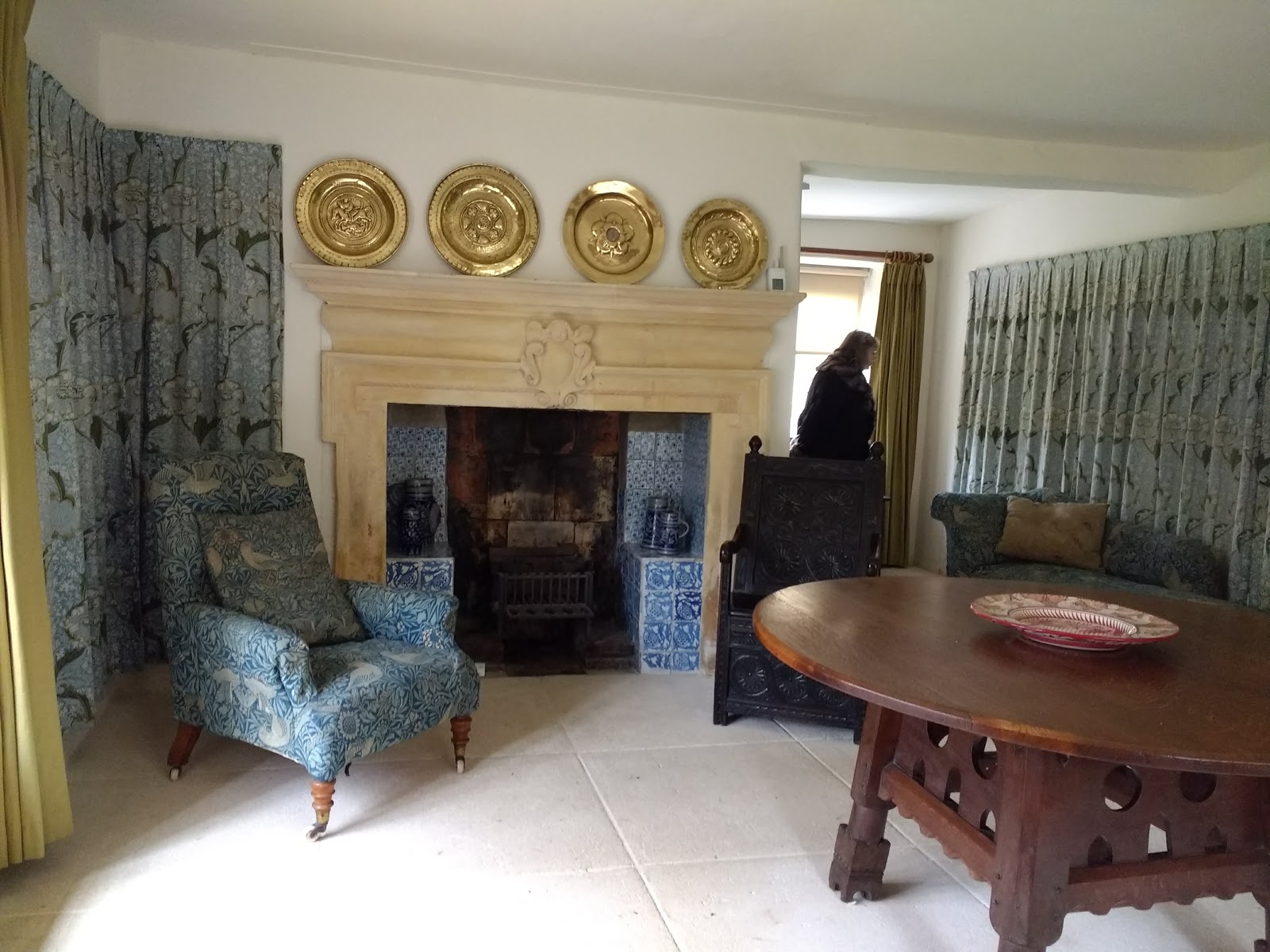


The weather was still a bit damp outside, but we enjoyed our trip to Kelmscott.

Thursday, April 5

Jonathan and Carrie left us on Thursday to go to London for a couple of days. They had a gorgeous day, for a change, after all of the bad weather that they endured in the Cotswolds.


I took a walk down the road to take some photos of the River Eye which went right by our little village. We have had so few nice days that I really appreciated this one.


Friday, April 6

Friday was our day to leave the Cotswolds. I really enjoyed not only our time there, but also staying in one place for nearly a month. I was there long enough to pretty much learn my way around.

We were headed to Kent for a little less than two weeks and picked up Larry's sister, Linda, at the airport on the way.

Our rental, just our third for our 7 1/2 weeks here in England, is very spacious with two bedrooms and two bathrooms situated at the ends of the space and the kitchen and common space in between. This is a perfect space for the three of us.


Saturday, April 7

One place that was high on our list of things to do was Chartwell, Winston Churchill's summer home. It is far enough outside of London to make it difficult to get there while in London, so we chose to go there while in staying in Kent. It was also necessary to have a car to get there.


The entrance to the house is rather unprepossessing, and considering that the Churchills made significant changes to the house, they must not have placed much importance on the front door. Some front doors are grand and full of fanciful stonework and others, even on very large houses, seem to be almost an afterthought. 

The inside of the house is clearly the home of someone of means, but not at all ostentatious.

This is Churchill's study.


This is Lady Churchill's bedroom/study.


Housed in the wing that they added is the dining room. It is on the first floor and has uncharacteristically low ceilings compared to the rest of the house. It has these large trellis-shaped windows looking out onto the gardens. The general effect of the room is informal, almost like a breakfast room. On a sunny day (eventually there will be sun!) it would be a lovely place to have tea and toast.


One small former bedroom of the house is devoted to Churchill's various "costumes" -- from the informal, his favorite lounging one-piece,  to the ultra formal, his ceremonial robes.

Pictured here are one of his ceremonial robes and his wartime uniform.


Thinking that Churchill might not be able to afford to keep up the house and its 80 acres, his friends raised the funds to purchase the house and maintain it. Lady Churchill gave it to the National Trust with the proviso that basically nothing should be changed. She wanted the British people to see how the house looked when it was lived in.

Not commonly known (by Americans) is that Churchill was a prolific painter. Although he did not start painting until he was 40, he produced over 500 paintings, all in oil, over the next 48 years, many of them on display throughout the house and his studio.

Sunday, April 8

Sunday promised to be a day without actual rain, so we took a trip to Canterbury.


Canterbury is a city with many very old houses and shops. This book shop is probably the most photographed building in the city (aside from the Cathedral, of course).


This building, which probably dates from the mid-1500's has evidently been leaning at a precarious angle for some time. A famous Victorian author (whose name I have forgotten at the moment) remarked on its leaning more than a hundred years ago.

The major attraction, of course, is the Cathedral.


Canterbury Cathedral and the Archbishop of Canterbury are to the Church of England as the Vatican and the Pope are to the Holy Roman Catholic Church. However, the Catholics with all of their Renaissance art, colorful vestments, Swiss Guards and general pomp and ceremony do a much better job of being important. In a typically British way, the Cathedral and all that goes with it is quietly regal and low key for being the administrative seat of the Church. 

I would guess that at least part of the edifice is under scaffolding all of the time. There seems to be a continuing conservation program in progress to clean and/or repair portions of the stonework. Without maintenance, these wonderful stone facades will very slowly disintegrate and crumble.


These two statues stood out amongst all of the others because they look so clean, which actually gives us an idea of what the church might have looked like when newly built.

A closer inspection revealed that this is Queen Elizabeth II and Prince Philip.

I don't think that the statue of the Queen much resembles her.


I can't imagine what it would be like to see a statue of yourself. I suppose that if you are a monarch you would get used to it. After all, the portrait of the monarch is used on everything from the money to kitschy souvenirs. But seeing a statue of one's self might be slightly creepy since statues are usually of the deceased.
Wednesday, April 4, 2018

Blenheim and Beyond

Tuesday, March 27

Tuesday was another not very nice day, but probably the best, weather wise, of the next few days according to the forecast. So, we decided that it would be a good day to go to Blenheim.

We had not been to Blenheim since our family trip in 1985, having skipped over it the last few visits to England. Since it is so close to us and it had been quite a while, it seemed like a good outing.

We had experienced very slow traffic going through Burford on our way to Oxford last week, so we carefully chose a longer but construction-free route, saving us at least a half hour of annoying stop and go traffic to get there. Somehow, going the extra miles never seems as annoying as sitting in traffic -- especially with a six speed transmission.

Blenheim is spectacular. Not only that, but the family actually still lives there. That would be the 12th Duke of Marlborough and his family. 

A little history about Blenheim: First, it is called a palace instead of a house because it actually was a royal palace that was given by Queen Anne to John Churchill in 1702 as a reward for being successful in the war of Spanish Succession (Spain gobbled up all of the land along the water line north and east of them, effectively cutting England off from access to mainland Europe). One of his battles was in Blenheim, (now in Germany), therefore, the palace took that name in honor of his victory.


He also was rewarded with a title and became the 1st Duke of Marlborough, among other titles with the dukedom being the highest.

And, so, the title was passed down from father to son for twelve generations to the current Duke who is in his mid-60's, most likely assuring a long tenure for him. Dukes are the highest ranking of the many British titles, but they are not always the most upstanding citizens, especially when they have simply inherited a title and not specifically earned it themselves. This is truly the case with the 12th Duke of Marlborough. In researching the palace, I found that at one time, the Duke's father went to court to have #12-to-be removed from the line of succession, due to his 30 years of drug and alcohol addiction and more than 20 convictions for same (plus burglaries and punching an officer).

By the time that the 11th Duke died at the age of 88, father and son had reconciled, due to the backroom efforts of the 11th Duke's fourth wife, and James Spencer-Churchill became the the 12th Duke of Marlborough.

The Telegraph printed this headline of the succession:


"Former drug addict and ex-convict Jamie Blandford becomes 12th Duke of Marlborough after father dies"


English names and titles are very confusing to most Americans, so here's a primer. The 12th Duke was known as Jamie Blandford because the oldest son of the Duke of Marlborough gets the title of Marquess of Blandford. There's another thing we don't understand; a marquess. Immediately upon his father's death, he became the new Duke and his eldest son became the new Marquess of Blandford. So, sometimes when a man gets a title, he is then known by that name instead of his family name, which means that people in the same immediate family can have rather different names. Those British are so confusing.


We were visiting Blenheim, remember? It has something like 140 rooms. Some are used by the family, some are used for storage, some are probably in a massive state of neglect and, some are open to the public. 

When the 1st Duke was given the property, it was a much smaller house, used as a hunting lodge by the royals. The Duke (or, actually his wife, the Duchess) convinced the crown to expand it significantly and improve the grounds to make them less for hunting or more for beauty. Over the years, the Duke kept adding to the building, eventually using his own money, or maybe that of his wife as she was the wealthiest person in the kingdom and beyond. 

Here are some of the additions over their time at Blenheim and that of future generations:

Part of the massive front gate:


The library:


The pipe organ which was being tuned that day:


The garden terrace wall, complete with fountains:


And some of the formal pools which were being filled that day:


Some of the stable spaces have been converted to exhibition spaces, since the family apparently does not keep horses anymore. The exhibit this time focused on Victorian era art and vehicles. I particularly liked this one:


and this one:


I could just picture the family being driven to the train station in this car.


Wednesday, March 28

We didn't have anything in particular planned for the day, and as usual, the day was raining on and off, so we decided to take a drive through the countryside through a scenic route marked out on the map.

This is Stanway, which is literally a bend in the road. Or, more specifically, it is two bends in the road forming somewhat of an "S". It is such a typical Cotswold mini-village. This was the manor house and there were perhaps a half dozen other houses in town.


The house is large, but not as imposing as this front gate might suggest:


Thursday, March 29

As usual, the weather was not all that wonderful, but there was a chance of brighter skies in the afternoon, so we decided to go to Coughton Court, about an hour north of our cottage. It is another of the National Trust properties.

However, about 20 minutes into our drive, I hit a serious pothole and put a hole in the tire. We could not go anywhere until I got a replacement. There was no spare in the trunk so I called for service. The AA serviceman came in less than an hour and I thought that we might be on our way, but that was not to be the case. He brought with him a spare, but he could not leave it on the car, so we had to follow him to a tire dealer in Worcester about 30 miles away to get a replacement. Because we did not have an appointment, we were just about the last in line for service.

In the meantime, we were hungry and we wanted to do something other than spend hours in the waiting room. The serviceman from AA (the British version of AAA) suggested a National Trust house a block away. This turned out to be serendipity. 

Greyfriars was originally built in the mid 1500's as a rather small house and as is often the case, it was increased in size over a couple of centuries until it looked like this:


First, we found their tea shop and lacking anything else on offer, we had a cream tea. Then we went through the house. The docents in the house were about the most knowledgeable of any that we have met, and that is saying quite a bit. National Trust docents are very well informed about their properties, but these were way beyond that. We were treated to about a half hour private talk by a rather elderly gentleman who knew the history of the house inside and out.

The last owners of the house (an unmarried brother and sister) were afraid that the buildings across the street, from the same time period, would be destroyed and some new architectually inappropriate buildings would be erected in their place. To forestall that action which seemed nearly certain, they purchased the buildings and eventually gave both the house and the buildings opposite to the National Trust to further ensure that they would never be destroyed. The National Trust rents them out to shop owners and they are still being used today, much the same as they were in 1560, or so.


Friday, March 30

We have reached a month of being in England (actually a couple of days ago), the first couple of weeks in London and now in the Cotswolds.

When we first arrived in the Cotswolds,  our son Jared and his wife Evelyn joined us for almost two weeks, then we had a week by ourselves, and on Friday, March 30, our son Jonathan and his wife Carrie and our grandkids, Molly and Henry, joined us for a few days during the school vacation.

After restocking the larder for their visit, we stayed around the cottage to be available when they arrived.

As is always the case, jet lag had its affect on them and they really needed to have some "quiet time" after they had lunch.

Saturday, March 31

Another rainy day. This is England, after all. However, the forecast for the entire next week is rain or drizzle with at least a heavy cloud cover guaranteed every day. We had a choice to just stay in the cottage for the entire time or put on our raingear and brave the drizzle. I draw the line at actual pouring rain, but I can handle drizzle. I don't like it, but I handle it -- and so did everyone else.

Off we went, about four miles from here to the Cotswold Farm Park. When we came to England in 1985 with our sons aged 11 and 13, the Farm Park was a big hit with them, but it was a simple park of mostly rare breeds of farm animals. The owner wanted to address the shrinking number of rare breeds (cows, pigs and sheep primarily) in the country, so he established this park as a breeding place.

Now, more than 30 years later, the owner has died and his son has taken over the stewardship of the park. To keep it financially viable, he has enlarged it and added many educational aspects as well as some kid-friendly fun activities. Our grandkids rushed over to "milk" the "cow", each taking a turn.


Inside the barn, young lambs were being bottle fed at regular intervals. This proved a big hit with the kids and many of their parents as well.


This was a huge photo op with the lambs being fed on one side of the pen and the photographers with cell phones in hand on the opposite side of the pen. The lambs got only a few ounces per bottle and they gulped it down in a split second.

There were also lots of day old baby chicks for people to touch. 


There was also a lambing barn where pregnant ewes and mothers with their lambs born today were held. After the mothers and their lambs are securely bonded with each other, they are moved to communal pens with several mothers and their lambs together until finally going out to the pasture. The tiny little hours-old lambs were so absolutely adorable with their wobbly little legs.

A lot of the pasture land was suffering the mud slump from all of the rain recently, so quite a bit of it was cordoned off. The part that was still open was pretty mucky. 

Both of the kids had a great time on the zipline which was low enough that at their ages, they did not need any help with it.


Sunday, April 1 (Easter Sunday)

While Jonathan's family went to see Stonehenge, Larry and I went on another attempt to see Coughton Court which was short circuited by the flat tire a couple of days prior.

This time, the trip went well, though we purposely chose a different route to avoid the dangerous potholes.


Coughton Court (pronounced "cowton") is a rather large manor house in the continuous ownership of the Catholic Throckmorton family for 600 years. That in itself is remarkable, that a property would not have been sold or forfeited for being on the wrong side of politics. But, even more remarkable is that the family survived the Catholic purge of Henry VIII and his various successors. The house did not sustain any damage or major neglect throughout all of those centuries. 

The Throckmortons still live there in one wing of the house, and have like so many other families, given the house over to the National Trust in lieu of estate taxes. I swear, in a couple more generations, the National Trust will own every large house in England. 

Coughton Court is fortunate to have a nearly complete gallery of portraits of Throckmortons throughout the centuries. The house is just full of portraits. There is little other art, but dozens and dozens of portraits -- and those are only the ones on view to the public. An even larger collection is in the private portion of the house.

I can't really imagine what it would be like to live in a house that is so old, so large and so open to the public. To have people wandering around your garden looking at your plants, and trooping through your house just astonishes me as a way to live. Every so often, when at a house like this, we actually see some member of the family driving out of the property, sometimes using the same drive where tourists are walking. 

Since the family lives there, only a fairly small portion of the house is actually open to the public, but enough to get an idea about the architecture and the furnishings.


As we went through the house, we heard lovely piano music. I kept thinking that it would be wonderful if it was live music, but sometimes there is music in parts of a house for effect. When we got to the sitting room, we were so pleased to see this lady playing so expertly. 


In the evening (of Easter Sunday), Jonathan provided the whole family with a super treat in the form of all you can eat dessert. Ever since our last visit to England four years ago, Larry has been talking about the Pudding Club, a weekly event held at the Three Ways House, a restaurant (with rooms) in the village of Mickleton near Chipping Camden.


Because England celebrates Easter with a four day weekend, (being Good Friday, Easter Saturday, Easter Sunday and Easter Monday) the restaurant offers an extra Pudding Club night. They were sold out for Friday, so we chose Sunday.


The idea is that you get a rather small entree and then the business begins. There are seven English puddings served each night. Everyone gets as many servings of any of them as they like. Apparently, the record is 25 servings. 

So, what is an English Pudding? They come either hot or cold. Generally, I much prefer a hot one. The cold ones are generally meringue based or something with gelatine and whipped cream. A hot pudding is basically a steamed cake, often infused with a syrup of some flavor. 

We didn't do nearly that well, but we didn't put our table to shame either. 


With the exception of Henry who has a very small appetite, we all tried each of the seven puddings (or, "puds" as they are colloquially known).


At the end of the evening all participants voted on their favorite pudding. Apple crisp was high on the list, pushing out the chocolate by a country mile. The passion fruit meringue roulade also did well. Others were not as popular, but all of them were delicious.

This was one fun evening out. 


Monday, April 2

Monday was another day of on-again, off-again drizzle, but we braved the weather to go to the Model Village in Bourton-on-the-Water. 


We went there in 1985 with our kids, but I had mostly forgotten about it. It was interesting to view the miniature village through the eyes of our grandkids.

An interesting thing about the village is that it is an exact replica of the village itself. As the names of the shops and restaurants change, in the real village, the names are changed to match even down to the logos on the signs, in the miniature village.

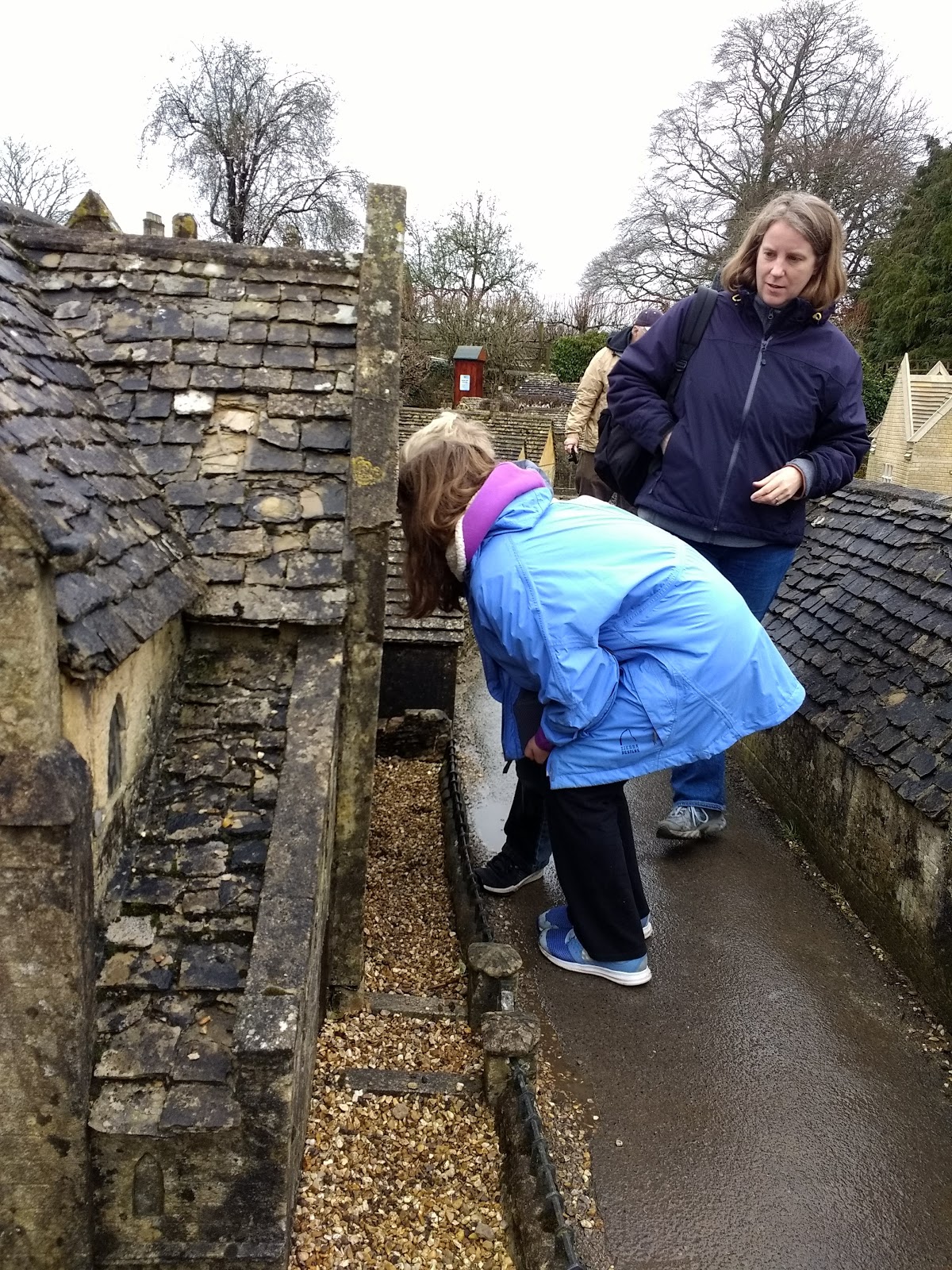
I had remembered seeing the name of a bakery in the miniature village and that gave me the idea to go and buy some fresh scones to have with tea back at the cottage. The problem was that after leaving the miniature village, I couldn't remember exactly where the bakery was located. A quick dash back to the ticket booth and I had my answer, because if anyone would know the location of anything in town, it would be the people at the miniature village. I got my scones and they were about the best ones that I have ever had.

.